TL; DR
-
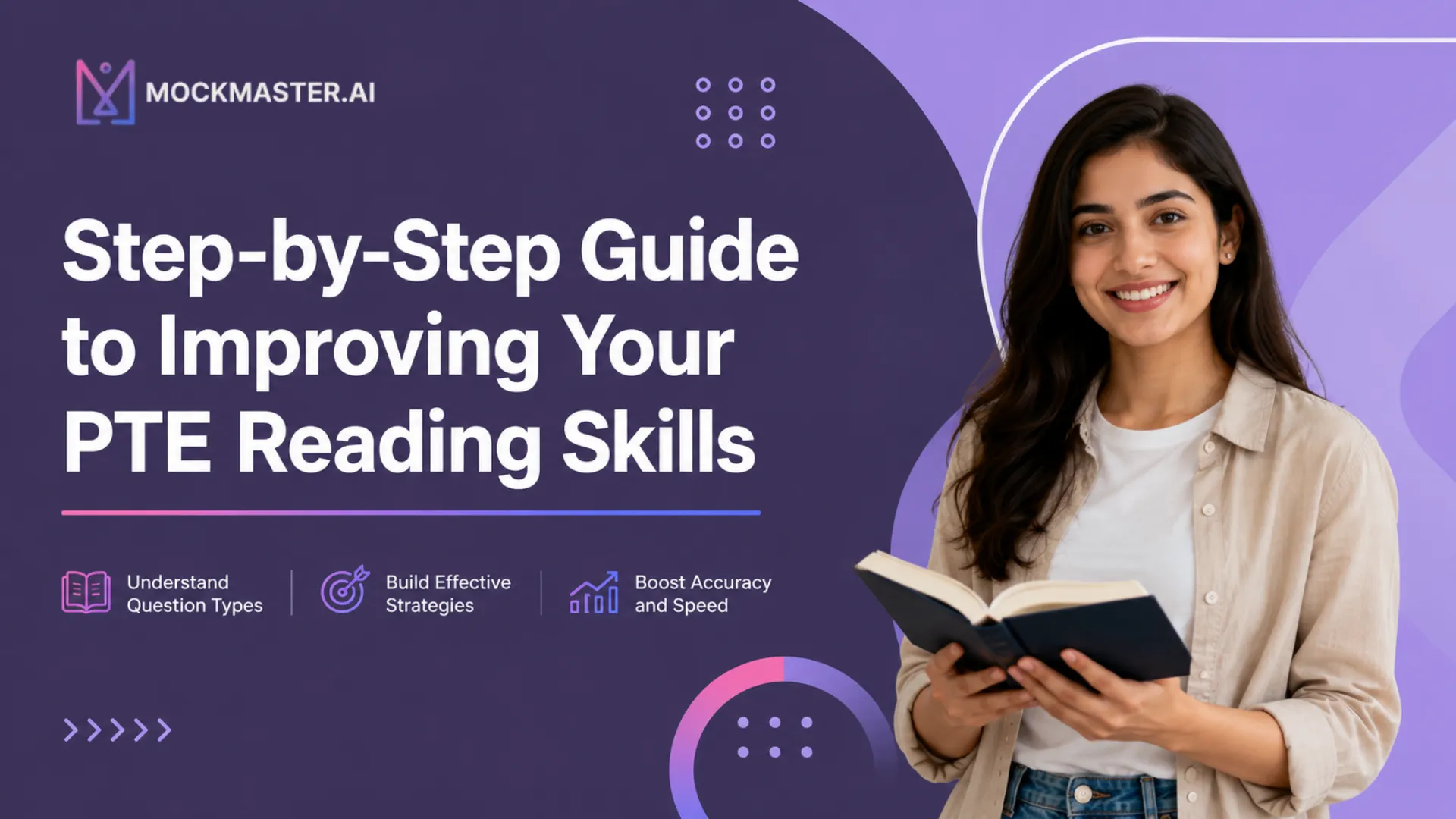
The PTE Reading section is tough but manageable with focused practice.
- Key question types: Reading & Writing: Fill in the Blanks, Multiple‑choice (single and multiple), Reorder Paragraphs, and Reading: Fill in the Blanks.
- Use skimming, scanning, and keyword spotting to save time and improve accuracy.
- Regular PTE practice reading on AI‑powered platforms like Mockmaster.AI sharpens skills and boosts confidence.
- Aim for strong vocabulary, grammar, and logical sequencing to target high scores like 79+ in PTE Reading.
Related Blogs
- PTE Reading Tips: Strategies to Improve Accuracy & Speed
- Understanding PTE Academic Reading: Successful Tips
- PTE Academic Reading Skills with Expert Tips & Tricks
Are you preparing for the PTE exam? If yes, then you must not miss this segment. You might already be very familiar with the exam format, but preparing strategically is the real secret to scoring high. The PTE Academic test is divided into four core sections: Speaking, Writing, Reading, and Listening. Out of these, the Reading section is widely considered the most challenging for many test‑takers. That’s why targeted PTE practice reading is essential if you want to clear this section with confidence and boost your overall band score.
In this guide, we’ll walk you through a step‑by‑step plan to improve your PTE Reading skills, covering all question types, smart strategies, and how you can use Mockmaster.AI to practice effectively. By the end, you’ll know exactly how to approach each task, manage your time, and turn PTE practice reading into your strongest skill.
Why the PTE Reading Section Feels Tough
The PTE Reading section can feel daunting because it tests more than just your vocabulary. It evaluates your ability to comprehend complex academic texts, identify main ideas, infer meaning, and process information under strict time limits. The section lasts about 23–30 minutes and includes 14–20 questions across multiple formats, all at PTE exam level difficulty.
Without structured PTE practice reading, many candidates struggle with:
- Running out of time
- Misunderstanding subtle differences between answer choices
- Getting confused by tricky wording and distractors
The good news? With the right techniques and consistent PTE practice reading, you can turn this section from a weakness into a scoring opportunity.
Question Types in the PTE Reading Section
Before diving into tips, let’s quickly review the five main question types you’ll face in the PTE Reading section:
- Reading & Writing: Fill in the Blanks (Dropdown)
- Multiple‑choice, Multiple Answers
- Reorder Paragraphs
- Reading: Fill in the Blanks (Drag and Drop)
- Multiple‑choice, Single Answer
Each of these requires a slightly different approach, but they all benefit from regular PTE practice reading and exposure to exam‑style passages.
1. Reading & Writing: Fill in the Blanks (Dropdown)
In this task, you’ll see a short academic text with gaps, and for each gap, you’ll have a dropdown list of options. You must select the most suitable word or phrase to complete the sentence while maintaining grammar, meaning, and cohesion.
How to Approach This Question
- Time is of the essence: Aim for 2–3 minutes per question. This gives you enough time to read, analyze, and double‑check without rushing.
- Focus on the question first: Read the entire sentence (and preferably the surrounding sentences) to understand the context and the logical flow.
- Eliminate incorrect options: Quickly discard choices that are grammatically wrong or semantically unrelated.
- Consider all possibilities: Even if one option looks perfect, quickly check the others to avoid falling for distractors.
How PTE Practice Reading Helps
When you do PTE practice reading on Mockmaster.AI , you get access to 500+ practice questions with AI scoring. This means you can repeatedly practice Reading & Writing: Fill in the Blanks and receive instant feedback on which words fit best in context. Over time, you’ll start recognizing common collocations, academic phrases, and grammatical patterns that appear again and again in the real exam.
Not sure where to start? Begin now with PTE practice reading on Mockmaster.AI and build your confidence with predictive, exam‑level questions.
2. Multiple‑choice, Multiple Answers
In this question type, you must select all correct answers from a list of options based on a reading passage. You’ll often need to identify multiple supporting details or ideas, not just the main point.
Smart Tips for This Task
- Understand the story: Figure out what the passage is about. The answers are usually hidden in the main idea and supporting details.
- Spot the keywords: Look for important words in both the question and the passage. These keywords will guide you to the relevant sentences.
- Watch out for tricky words: Words like “always,” “never,” and “all” can make an option too extreme and therefore incorrect.
- Don’t skip questions: There’s no penalty for wrong answers, so even if you’re unsure, make an educated guess.
- Eliminate wrong options: Cross out answers that clearly contradict the passage. This narrows down your choices and increases your chances of selecting the correct ones.
Why Regular PTE Practice Reading Matters
Consistent PTE practice reading trains your brain to scan quickly and identify key information under time pressure. Mockmaster.AI’s platform lets you practice this question type in isolation, so you can focus on improving accuracy and speed without getting overwhelmed by the full test.
3. Reorder Paragraphs
In Reorder Paragraphs, you’re given jumbled sentences or paragraphs and must arrange them into a logical, coherent text. This task directly assesses your ability to understand text structure, cohesion, and logical flow.
How to Master Reorder Paragraphs
- Identify the beginning: Start by finding the topic sentence or the sentence that introduces the main idea. This usually comes first.
- Look for connections: Pay attention to transition words like however, therefore, in addition, on the other hand, and for example. These signal how ideas connect.
- Apply logical sequencing: Arrange the sentences based on chronological order, cause and effect, or argument development.
Aim for 2–3 minutes per question to balance accuracy and speed. With enough PTE practice reading, you’ll start noticing common patterns in how academic texts are structured, making this task much easier.
4. Reading: Fill in the Blanks (Drag and Drop)
This task tests your vocabulary, grammar, and understanding of context. You’ll see a passage with several blanks and a word bank of options. You must drag and drop the correct word into each blank.
Effective Strategies
- Get the big picture: Quickly scan the text to understand its main idea and tone. This helps you predict the kind of words that will fit.
- Clues are everywhere: Pay close attention to the words before and after each blank. They often hint at the part of speech (noun, verb, adjective, etc.) and meaning.
- Don’t be afraid to guess: There’s no penalty for wrong answers, so use your best judgment even if you’re unsure.
- Focus on word order: Check if the missing word fits grammatically in the sentence. For example, does it match the tense or agreement?
- Synonyms are your friends: The missing word is often similar in meaning to another word nearby. Use this to eliminate unlikely options.
How Mockmaster.AI Boosts Your PTE Practice Reading
Mockmaster.AI offers exam‑level passages and drag‑and‑drop blanks that mimic the real PTE test. By doing PTE practice reading regularly on this platform, you’ll expand your academic vocabulary and become more confident in choosing the right word from a list of options.
5. Multiple‑choice, Single Answer
In this question type, you must select the single best answer that captures either the main idea or a specific detail from the passage. It’s deceptively simple many candidates lose marks by misreading the question or falling for close‑but‑wrong options.
How to Tackle This Question
- Understand the whole story: Read the entire passage carefully to grasp the main idea and supporting details.
- Spot the clues: Look for keywords in both the question and the answer choices that link back to the passage.
- Weigh your options: Carefully consider each answer choice and eliminate those that don’t match the passage or the question.
Again, PTE practice reading is key here. The more passages you read and questions you answer, the better you’ll become at spotting subtle differences between answer choices.
PTE Reading Section Exam Strategy
Now that you know the question types, let’s look at an overall exam‑day strategy for the Reading section.
1. Skim and Scan
- Skim the passage first to get the overall idea.
- Then scan for specific information when answering questions.
This focused approach ensures you absorb only essential details and avoid getting stuck on irrelevant parts.
2. Double‑Check the Question
Always read the question twice before selecting an answer. Misreading the question is one of the most common reasons candidates lose marks.
3. Identify Key Words
Highlight or mentally note keywords in both the passage and the questions. These will guide you to the correct information quickly.
4. Eliminate Incorrect Options
For multiple‑choice questions, systematically rule out clearly wrong answers. This increases your chances of choosing the correct option, even if you’re unsure.
5. Practice Regularly
Consistent PTE practice reading sharpens your skills, improves time management, and boosts overall performance. The more you practice, the more familiar you become with the exam pattern, question styles, and common traps.
How Mockmaster.AI Helps You Practice PTE Reading
Mockmaster.AI, is designed to give you realistic, AI‑scored PTE practice that mirrors the actual exam. Here’s how it supports your PTE practice reading journey:
- 500+ practice questions with AI scoring: Get instant feedback on your answers and understand why certain options are correct or incorrect.
- Question‑wise practice: Focus on specific question types like Fill in the Blanks, Multiple‑choice, Reorder Paragraphs, and more.
- Full‑length mock tests: Simulate the real exam environment with timed tests that cover all sections, including Reading.
- AI‑powered analysis: Receive detailed reports on your strengths and weaknesses, along with smart recommendations for improvement.
- Prediction files: Access curated lists of potential question types and topics to help you prepare more strategically.
By integrating PTE practice reading on Mockmaster.AI into your study plan, you’ll build confidence, improve accuracy, and reduce exam‑day stress.
Start Your Free PTE Mock Test with Mockmaster.AI
Ready to take your PTE Reading skills to the next level? Start your free PTE mock test and get AI‑scored analysis for a personalized learning journey.
- Kickstart your PTE prep with a free AI‑scored mock test.
- Boost your score with in‑depth analysis and smart recommendations.
Final Tips to Conquer the PTE Reading Section
Conquering the PTE Reading section demands strategic preparation and efficient time management. Understanding the various question types, implementing effective techniques like skimming, scanning, and keyword identification, and practicing regularly can significantly enhance your reading speed and accuracy.
Here’s a quick recap of what you should focus on:
- Do daily PTE practice reading using exam‑level materials.
- Build a strong academic vocabulary and improve your grammar.
- Learn to recognize common text structures and logical connectors.
- Use Mockmaster.AI to get AI‑scored feedback and targeted practice.
With dedication and the right approach, you can achieve your desired PTE Reading score and move closer to your study or immigration goals. Keep practicing, stay consistent, and let PTE practice reading become your secret weapon for success.
FAQs
1. How do I achieve a perfect 90 in every section?
Achieving 90 in every PTE section demands consistent practice, a clear understanding of the test format, and strong command over English. Focus on high‑weight tasks like Repeat Sentence and Write From Dictation, and maintain fluency, accuracy, and smart time management. Regular AI‑scored mock tests and detailed feedback from platforms like Mockmaster.AI help you identify weak areas and fine-tune your performance for a perfect score.
2. What are the best ways to boost my Reading score?
To improve your PTE Reading score, practice skimming and scanning techniques, build academic vocabulary, and strengthen grammar. Do targeted PTE practice reading for question types like Fill in the Blanks, Multiple‑choice, and Reorder Paragraphs. Use AI‑powered mock tests to track progress and review mistakes systematically.
3. What is the PTE equivalent of an IELTS 7.5?
An IELTS band 7.5 roughly equals a PTE Academic score between 73 and 79. This range shows strong English proficiency and is widely accepted for university admissions and visa applications.
4. What is the strategy for scoring 79+ in Reading?
Scoring 79 in PTE Reading requires speed and accuracy. Focus on Reading & Writing: Fill in the Blanks (Dropdown), practice skimming and scanning, and review incorrect answers to avoid repeating errors. Consistent PTE practice reading with timed tests is key.
5. Is a score of 57 sufficient for most applications?
A PTE score of 57 is decent and usually reflects an intermediate level of English. It may be acceptable for some undergraduate programs, but postgraduate courses and stricter visa requirements often prefer scores above 65.

Tushar Saluja